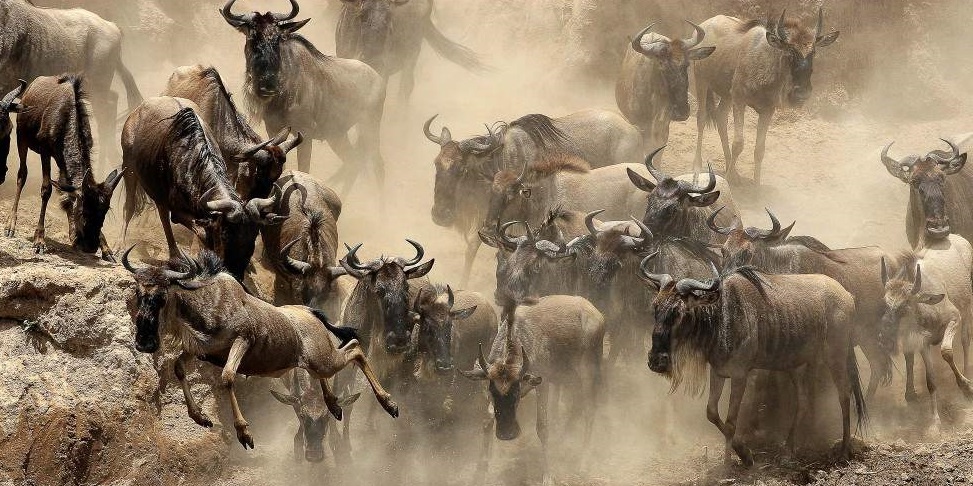
Wildebeest River Crossing in the Serengeti is one of the most spectacular and iconic animal kingdom phenomena. It is a natural occurrence and is known as the Great Migration, which happens annually, where millions of wildebeests, hundreds of thousands of Zebras and gazelles will meet over the expansive plains of Serengeti and Maasai mara ecosystems in East Africa. When these animals travel over the terrain in search of food and water, they encounter a very dangerous task; how to cross the vast rivers that divide various parts of the plains. These river crossings and especially those across the Mara and Grumeti rivers are some of the most phenomenal and thrilling views of the migration. This article will discuss five very intriguing views of the Wildebeest River Crossing in the Serengeti, the threats, tactics, and nature spectacle that makes it one of the most overwhelming occurrences in the natural world.
1. The Perilous Journey Across the River
Among the most prominent facts regarding the Wildebeest River Crossing in the Serengeti is the massive threats that these animals encounter when crossing the rivers. Although, Great Migration is a food and survival hunt, some of the most dangerous points of this yearly pilgrimage are river crossings.
The rivers of the Serengeti and Maasai Mara are swollen with rains and run fast in season and are full of hidden enemies. In the case of the wildebeest, it is not just a matter of survival after crossing these rivers but a suicidal matter. Trying to reach the water edge the herds of wildebeest may get lost and caught by the rushing stream which is able to carry them away with ease.
Besides the powerful currents, these rivers also bear a host of predators, such as crocodiles which are one of the major predators in the river crossings. Along the riverbanks, there are photographic crocodiles, some of which measure about 20 feet in length, waiting to give an attack, when the wildebeest tries to cross. Such top predators are very efficient and can attack with unbelievable speed and also the crossing is even more dangerous to the moving wildebeest.
The wildebeest have a policy of waiting until at one point as many of them that can be have congregated at the waterside before crossing as one large group. This group strategy gives a certain shield against predation since the group of animals is very large and individual wildebeests can be attacked. Yet, despite the strategy, lots of wildebeests lose their way to the fast streams of the river and to the grasping crocodiles so that the crossings through the river are the dramatic and sad spectacle of nature.
2. A Display of Survival Instincts
The most interesting fact about the Wildebeest River Crossing in the Serengeti is the great survival instincts that the wildebeests exhibit in the face of this difficult time. Although it might appear to be a chaotic and turbulent spectacle, the crossing does have its hidden logic, and none of the wildebeests is left to play its role in keeping the herd safe and successful.
The herd aspect plays a greater role in the survival of the wildbeests as they are social animals whose survival during the crossing highly depends on the herd mentality. When the wildebeests are coming to the river they are usually following the leader mostly an elder and more experienced animal of the herd that knows when it is time to cross the river. The crossing of the river and migration is motivated by a very strong instinct to remain united and to move together.
Funny enough, wildebeests are not the harmed animals who only use the herd mentality during the crossing. Gazelles and zebras have a way of crossing rivers with the wildebeests because they are migrating through the identical route as well. The zebras are however generally the more conservative ones as they are not such good swimmers as the wildebeests and are also prone to predators. All these animals may combine together creating a spectacular scene having wildebeest, zebras and gazelles crossing the river simultaneously forming a current of living bodies.
It is also shown how the survival instincts of the wildebeest are in order to head the river with remarkable dexterity. Although they do not swim naturally, the wildebeests float on the water pushing and pulling themselves with their powerful legs. This concentration on the herd and the ability to stick to its track to the end is a critical factor in their success since the weakest ones or those that break away are the ones who are mostly prone to being prey of the crocodiles or any other predator.
Although the river crossing seems chaotic and potentially risky, the survival instincts and cooperative action of the wildebeests enable them to overcome all the dangerous waters and move on with the migration. This is one of the most important measures that allow them to endure in the long and challenging trip through Serengeti and Maasai Mara.
3. The Role of Predators During the Crossing
The other interesting fact about the Wildebeest River Crossing in Serengeti is that predators play a huge role in this melodramatic event. Although the wildebeests have survival as the main factor when crossing the Mara River, predators, especially crocodiles, lions, and hyenas, are always on the lookout to attack.
The first type of predation during the river crossings is crocodiles who inhabit the Mara and Grumeti rivers, and which further increase the amount of danger in the already dangerous river crossing. When wildebeests come to the water, crocodiles lie in the dark waiting so as to attack unsuspecting game. Once a wildebeest has been snared by a crocodile, it is usually pulled to the water and drowned, and the rest of the herd is left to carry on the crossing. Wildebeest cannot get away easily since their deadly jaws can scratch bones on the crocodiles.
Besides crocodiles, lions, and hyenas are also opportunistic feeders that exploit the river crossings. These predators normally rest close to the riverbanks and, in most cases, at places the wildebeests are most vulnerable like along the shallow parts of the river. When the wildebeests are crossing the animals, the predators are trying to single out the weak or those which are hurt within the herd.
What further complicates the situation is the fact that the predators, particularly the crocodiles, will always prey on the most vulnerable of the herd- young, old, or injured wildebeests in the process of the crossing. They are an easy target compared to the stronger and healthier wildebeests that can cross the river with the herd with the ability to swim. This is a process of natural selection that only the fittest wildebeests make it through the crossing and proceed with the migration process.
Although the presence of predators gives the crossing of the river a sense of danger and urgency, it is also a reminder of the reality of nature that is harsh. The wildebeest migration is not only related to the question of survival, it also refers to the question of balance of life and death in the Serengeti ecosystem.
4. The Timing of the Wildebeest River Crossing
The Wildebeest River Crossing of the Serengeti is a very crucial factor in learning about the dynamics of the migration. The only time the crossing takes place is during the period between July and October with regard to the rainy season, and the availability of water and food. It is at this period that the wildebeests are introduced to the rivers Mara and Grumeti which serve as the main barriers on their way.
The behaviour of the predators and the weather pattern of the seasons also plays a part in determining the time the river crossings occur. The rivers may end up becoming even more swollen during the rains in the area which also makes the crossing more unsafe. The arrival of wildebeests to the rivers is however not random. The presence of fresh grass which is the survival need of the wildebeests plays in line with the herd instinct and migratory behavior.
When the wildebeests get to the rivers, they are tempted to drink water of the river, yet they are aware that they need to cross the river to proceed with their migration. This is not simply a matter of crossing the river but also a matter of trying to receive new grazing grounds at the other side. This is the most important time to the survival of the wildebeest, and can be as well dictated by the seasonal translocation of the herds and predators.
The crossing process may take in a few hours to days based on the size of the herd, as well as the risk that predators could present. Throughout this period, the wildebeests are always subjected to the dangers of being carried along by the stream or becoming prey of the predators. In spite of all these hazards, the herd has to move, possessing the need to survive and locate the new feeding lands.
5. Wildbeest River Crossing and its effects on the Ecosystem.
The jumping of the Wildebeest River in the Serengeti has numerous implications on the whole ecosystem. When the wildebeests and other herbivores traverse through the scenery, they contribute importantly to the environment by grazing the grasses, thus forming a balance of plants in the area. Moreover, the migration of wildebeest causes massive amounts of nutrient to be deposited into the ecosystem in their waste that improves the soil and fosters other plants and creatures.
The very river crossings also make a difference on the environment. The presence of the mass movement of wildebeests in the rivers can interfere with the aquatic ecosystem dislodging the sediment, and stirring up nutrients in the water. This will in turn sustain the fish populations, as well as other aquatic life. Moreover, existence of predators in the crossing points also helps in the control of animal population as only the strongest survive to cause the next generation.
Changing the ecological scene, the Wildebeest River Crossing in the Serengeti forms an important part of sustaining biodiversity and balance of the African savannah. It is an indicator of how all species are interrelated with each other and the contribution that each species makes towards maintaining the fragile balance in nature.
Conclusion
One of the most exciting and dramatic in the natural world is the Wildebeest River Crossing amidst Serengeti. It is a spectacle of both nature and violence of nature that demonstrates the survival skills of the wildebeest when they confront perils of swiftly moving rivers, crocodiles and predatory animals. The Wildebeest River Crossing is a marvel as to how strong these creatures can be and their capacity to work with the extreme conditions of the African plains due to the dangerous crossing of the river and the effects they have on the ecosystem. The river crossings together with the Great Migration is not merely a survival tale, but a miracle of nature and how he/she manages to keep living even in the harshest of circumstances. Knowing these facts about the Wildebeest River Crossing in the Serengeti makes us see how complex the phenomenon of the river crossing is and how it influences the big picture of the life in the Serengeti.