
Understanding taxes is essential when travelling or conducting business in Africa. One of the most significant taxes is Value Added Tax (VAT), which is applied to goods and services in most African nations. Whether you are a tourist purchasing souvenirs, a business person importing goods, or simply curious about taxation in Africa, knowing the VAT rates in Africa is crucial for budgeting, financial planning, and compliance.
VAT is a consumption tax imposed on the price of goods and services. Rates vary by country and can significantly affect the final cost of purchases for travellers and the overall cost of doing business. This guide provides a comprehensive overview of VAT rates across the African continent, explaining how they affect travellers and businesses, and covering VAT refunds, exemptions, and compliance.
Understanding VAT in Africa
Before diving into specific rates, it is helpful to understand what VAT is and how it functions.
Definition: Value Added Tax (VAT) is a consumption tax levied on goods and services at each stage of production or distribution.
Purpose: VAT provides governments with revenue to fund public services and infrastructure.
Who Pays: The end‑consumer ultimately bears the cost, but businesses are responsible for collecting and remitting the tax to tax authorities.
The price of goods and services usually includes VAT. Some nations, however, allow VAT to be shown separately, especially on business transactions. Understanding the VAT mechanism helps businesses set prices and enables visitors to estimate costs accurately.
Why Knowing VAT Rates in Africa Matters
For travellers, knowing VAT rates in Africa helps with:
- Calculating total costs when shopping or dining.
- Planning for VAT refunds on eligible purchases.
- Avoiding unexpected charges.
For businesses, understanding VAT rates is essential for:
- Pricing products and services correctly.
- Complying with tax laws.
- Claiming input VAT credits on business purchases.
Knowledge of VAT rates contributes to effective financial planning and prevents unexpected costs or legal complications.
VAT Rates in African Countries (2026)
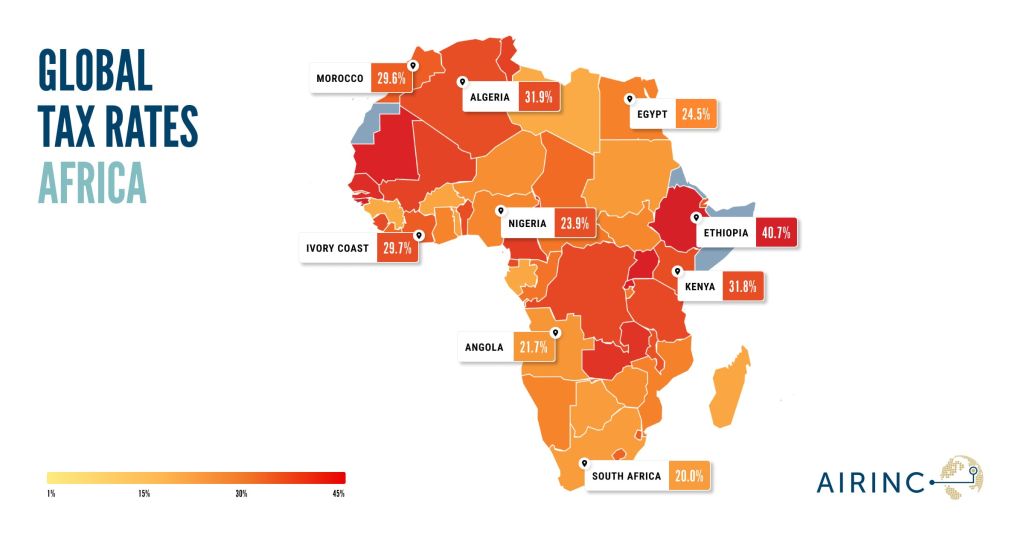
VAT rates across Africa vary considerably. Below is a summary of current standard rates for major destinations:
| Country | Standard VAT Rate | Notes |
|---|---|---|
| South Africa | 15% | Zero‑rated exports; reduced rate of 9% for commercial accommodation |
| Kenya | 16% | Temporary 8% rate on petroleum products (90‑day period); 15% proposal under consideration |
| Tanzania | 18% (Mainland) | Reduced rate of 16% for specified B2C purchases via approved electronic payments |
| Nigeria | 7.5% | Lowest rate among African peers; proposals to increase have been deferred |
| Ghana | 15% + levies | Effective rate of 20% (15% VAT + 2.5% NHIL + 2.5% GETFund) |
| Morocco | 20% | Transitional rates of 10%, 14%, and 7% apply to certain goods |
| Egypt | 14% | Reduced rate of 5% for medical devices and certain goods |
| Botswana | 14% | Registration threshold: BWP 1 million |
| Tunisia | 19% | Reduced rate of 7% for electric vehicle charging devices and certain inputs |
| Uganda | 18% | Zero‑rated exports; registration threshold: UGX 150 million |
| Rwanda | 18% | VAT applies to digital services |
| Zambia | 16% | Zero‑rated exports and basic foodstuffs |
| Zimbabwe | 15.5% | Increased from 15% effective 1 January 2026 |
| Mauritius | 15% | VAT on digital/electronic services from foreign suppliers from 1 January 2026 |
| Malawi | 17.5% | Increased from 16.5% effective 1 January 2026 |
| Mozambique | 16% | Reduced rate of 5% for certain supplies |
| Angola | 14% | Reduced rates of 1% in Cabinda Province and 5% on industrial equipment |
| Namibia | 15% | Standard rate applies across most sectors |
| Senegal | 18% | Reduced rate of 9% for certain goods; tourism activities taxed at 10% |
| Ivory Coast | 18% | Reduced rate of 9% for certain agricultural products |
| Cameroon | 19.25% | Reduced rate of 10% for social housing |
| Ethiopia | 15% | Registration threshold: ETB 1,000,000/year |
| Mauritania | 16% | Zero‑rated exports |
| DRC | 16% | Standard rate applies to most goods and services |
Note: VAT rates are subject to change. Always verify current rates before travel or business transactions.
Types of VAT in Africa

African countries may apply different VAT rates depending on the nature of goods or services:
- Standard Rate: Applied to most goods and services.
- Reduced Rate: Often applies to essential items such as basic foodstuffs, medicines, and transport.
- Zero Rate: Applied to exports, international services, or certain tax‑exempt items.
- Exempt Goods: Some goods may be completely exempt from VAT.
Understanding these distinctions is important for travellers seeking VAT refunds and for businesses calculating invoices and prices.
VAT Implications for Travellers
Knowing VAT rates in Africa is especially important for tourists, as many countries offer VAT refunds on goods exported by travellers.
- Eligible Purchases: Clothing, jewellery, electronics, cosmetics, and luxury goods.
- Refund Process: Travellers typically require receipts, VAT refund forms, and customs validation at departure.
- Exemptions: Consumables such as food and beverages, and services such as hotel accommodation, are usually excluded.
Example: In Morocco, the standard VAT rate is 20%. A souvenir priced at 200 MAD would include approximately 33 MAD in VAT. Claiming a refund at the airport can save money if the correct procedures are followed.
Claiming VAT Refunds as a Traveller

Claiming VAT refunds is one of the most practical benefits of understanding VAT rates in Africa. The process generally involves:
- Shopping at Registered Retailers: Look for stores offering tax‑free shopping.
- Obtaining VAT Refund Forms: Issued at the point of sale.
- Presenting Goods at Customs: Items must be shown to officials for verification of export.
- Submitting Forms: Refunds may be provided in cash, by credit card, or by bank transfer.
Keep all receipts, forms, and documentation to ensure a smooth refund process.
Country‑Specific VAT Insights
South Africa
- Standard rate: 15%
- VAT registration threshold increased to R2.3 million from 1 April 2026
- Refunds available to international travellers at airports with proper documentation
Kenya
- Standard rate: 16%
- Temporary reduction to 8% on petroleum products for 90 days from April 2026
- Limited VAT refund schemes, generally for high‑value goods from registered retailers
Tanzania
- Standard rate: 18% on the mainland
- Reduced rate of 16% for certain B2C purchases made via approved electronic payment systems
Morocco
- Standard rate: 20%
- Reduced rates of 7%, 10%, and 14% apply to specific goods
- Refunds available on eligible goods purchased from approved stores, processed at airports
Egypt
- Standard rate: 14%
- Reduced rate of 5% for medical devices and certain goods
- Refunds processed at major international airports, mainly for luxury products
Nigeria
- Standard rate: 7.5%
- Despite proposals to increase VAT, the rate remains at 7.5% for 2026
VAT Implications for Businesses
Businesses operating in Africa must consider the impact of VAT on pricing, accounting, and compliance:
- Input VAT: VAT paid on business‑related purchases can often be claimed as input tax credits.
- Output VAT: Tax charged to customers must be remitted to tax authorities.
- Compliance: Failure to register for VAT or pay taxes can result in penalties, fines, or business closure.
Companies should understand local VAT regulations, including registration thresholds, reporting deadlines, and exemptions.
Traveller Tips for VAT

- Check Local VAT Rates: Before shopping, check the standard rate to calculate potential refunds.
- Shop at Approved Stores: Only purchases from VAT‑registered retailers are eligible for refunds.
- Keep Receipts and Forms: Proper documentation is essential for recovering refunds.
- Know Exempt Goods: Understand which items are not covered by VAT refunds.
- Allow Time at Airports: VAT refund procedures can be time‑consuming – arrive early.
With these tips, travellers can maximise their VAT refunds while staying compliant with local laws.
VAT Challenges in Africa
- Variable Rates: Different rates for different goods can be confusing.
- Documentation Requirements: Missing or incorrect forms can invalidate refunds.
- Refund Locations: Refunds are often only available at airports or major border crossings.
- Legislative Changes: VAT rates may change without notice, affecting expected refunds.
Awareness of these challenges helps travellers and businesses manage expectations and avoid mistakes.
The Future of VAT in Africa
Many African governments are modernising their VAT systems:
- Digital VAT Filing: Online filing for businesses.
- Electronic Invoicing: Helps with compliance and reduces fraud.
- Tourist Refund Programmes: Expansion of VAT refund schemes to boost international tourism.
Keeping up with these trends ensures travellers and businesses stay informed about changes in VAT rates in Africa.
Conclusion
VAT rates in Africa are an important consideration for both business and travel budgeting. By understanding standard rates, exemptions, and refund procedures, travellers can make accurate purchases and claim the refunds they are due, while businesses can maintain compliance and optimise pricing.
Whether you are in South Africa, Morocco, Egypt, or Kenya, knowing the VAT rates ensures that shopping, dining, and business transactions are efficient, cost‑effective, and free of legal complications. Remember that being informed about VAT rates in Africa is not only about saving money – it is about being a responsible and confident traveller or business person.
With careful planning, good record‑keeping, and awareness of country‑specific policies, taxation in Africa can be transformed from a burden into a manageable part of your journey or venture.